
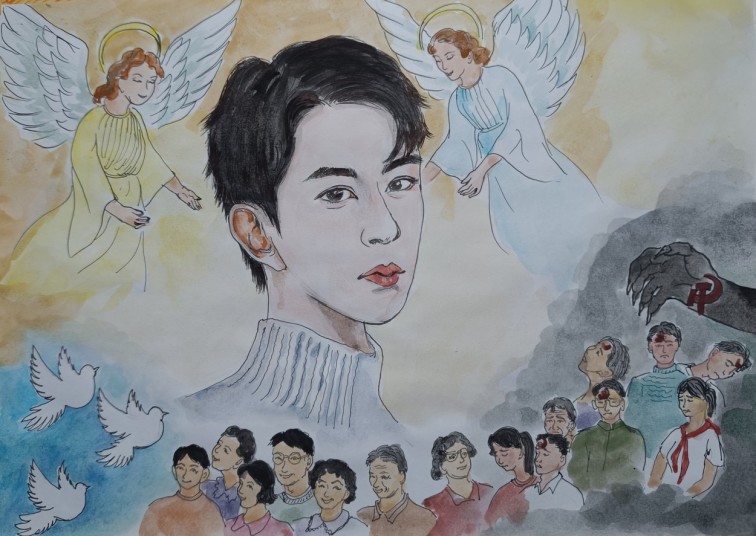
Yu Menglong has successfully withdrawn from the scene. (Illustration by People News)
[People News] Recently, Chinese actor Li Tingzhe released two videos in quick succession, proclaiming 'good news.' He asserted that the Chinese entertainment industry is truly on the verge of collapse. In reality, the turmoil within China's entertainment sector has long misled the public, particularly the youth, regarding their social views, life perspectives, and values, which can be described as deeply harmful. This situation stems from the Chinese Communist Party's exploitation of state-owned capital and power to ensnare the public in a state of 'entertainment to death.' This not only allows them to amass vast profits but also leads the public to drift away from political engagement under a false sense of happiness, abandon their ideals, and unwittingly submit to dictatorial rule.
The phrase 'entertainment to death' is derived from the book of the same name by American scholar Neil Postman. Postman primarily uses American society as a case study, noting in his book that all public discourse in reality increasingly manifests as entertainment, evolving into a cultural ethos that results in our becoming a species entertained to death.
Postman does not entirely oppose entertainment; rather, he critiques the detrimental effects of an entertainment-centric cultural trend on various domains, including society, politics, and education.
In recent years, the Chinese people's intense pursuit of the entertainment industry has emerged as a significant cultural phenomenon. From films and music to online variety shows, entertainment content is omnipresent, profoundly shaping people's lifestyles and values. While the abundance of diverse entertainment content may seem to enhance people's happiness, excessive engagement in entertainment can lead to public distraction, diminishing attention and reflection on critical social and cultural issues.
In a recent video, Li Tingzhe revealed that there is a widespread boycott of the entertainment industry across the internet, and it is already showing some results. Based on the data and current circumstances he has observed, it appears that the domestic entertainment sector is truly on the brink of collapse.
Li Tingzhe shared a set of statistics he encountered over the past two days concerning the entertainment industry. The data indicates that by 2025, the industry will face an unprecedented wave of unemployment, with 65% of actors having no roles throughout the year. He estimates that the figure could be as high as 80%, excluding short dramas, which are part of a new and emerging sector. This issue extends beyond actors; directors and producers are also struggling to find work, resulting in significant unemployment, with some being compelled to resort to live-streaming sales.
Additionally, he presented another set of figures: in 2020, the average income for actors was 8 million, but it has now plummeted to under 2 million. He believes this figure is misleading; in reality, many stars' salaries have dropped to just one-tenth of their previous amounts, and ordinary actors are earning even less. He candidly stated that if the entertainment industry continues on this path, it will inevitably collapse.
Li Tingzhe had previously posted a video discussing the downturn in the mainland film industry. He noted that, according to incomplete statistics, approximately 400 films are expected to be released in 2025, which is similar to the annual output in previous years. However, in the past, at least 10% to 20% of films were profitable each year, translating to around 30 to 40 successful films. This year, he estimates that if 10 films out of the 400 manage to turn a profit, it would be considered a success.
Li Tingzhe has observed that this year's films, aside from 'Ne Zha,' which can barely fill the seats, have attracted very few viewers. He has personally experienced being the only audience member in an entire cinema. He predicts that if this trend continues, half of China's cinemas could close down.
Supporters of this vague phenomenon expressed online, stating, 'It's good that it's failing; this is the outcome we wanted,' and 'How many brothers and sisters have come to despise the entertainment industry since 9/11? Some are making a fortune while others have no cars, no homes, and have even lost their lives. We see through it, and we have finally awakened!' Other netizens mentioned that even affording meals has become a challenge, let alone having money to go to the movies.
The phenomenon of 'the domestic entertainment industry is going to fail' directly signals the failure of the Chinese Communist Party's strategy of keeping people 'entertained to death.' The original plan of the authorities was to saturate people's lives with various forms of entertainment, allowing them to gradually become accustomed to avoiding political discussions: 'I pursue my stars, you manage your corruption, and this way, both sides benefit.' However, when everything is presented in an entertaining format, people may lose their capacity for deep thought and rational discourse.
Of course, if those within the entertainment industry do not wish to remain at a superficial and tedious level and seek any meaningful development, they will soon encounter political limitations.
Recently, some self-media outlets reported that mainland crosstalk performer Guo Degang was summoned for questioning. It is reported that the Beijing Xicheng District Cultural and Tourism Bureau officially summoned the Deyun Society on December 5, accusing Guo Degang and Yu Qian of having 'vulgar content and inappropriate implications regarding state-owned theatre groups' in their crosstalk performance 'Art High, Courage Low' at the Beizhan Theatre, and demanded immediate rectification.
The complete video that has surfaced online reveals that Guo Degang repeatedly mocked, without naming, a certain "crosstalk artist" within the Chinese Communist Party (CCP) system with whom he has conflicts, as well as the state-owned crosstalk art troupe of the CCP during his performance.
He noted that the state-owned art troupe he "once worked for" engaged in internal snitching, resulting in the elimination of all professional performers, leaving the entire troupe "composed of leaders, with only four performers remaining." He further joked that when the troupe went out for visits and was entertained, the dishes ordered by the troupe leader all had sexual connotations, ridiculing the officials within the CCP system for their inherent debauchery, stating, "They are not raised by humans."
Following Guo Degang's questioning, a segment of his performance circulated online, in which he seemingly cursed the CCP in a veiled manner: "I am just a maggot that has been asleep for a thousand years. If one day I wake up, I will definitely disgust the whole world."
Thus, the CCP's strategy of "entertainment to death" aims to have the Chinese people accept, obey, and support the CCP's dictatorial rule while indulging in pleasure. When people use their imagination and creativity to mock and ridicule the CCP within this "entertainment to death," it poses a danger to the ruling class and represents an insurmountable red line. Authoritarians have always hoped that the people would truly "die" in monotonous and boring entertainment.
Unexpectedly, the emergence of the Yu Menglong incident, with a shocking speed beyond the CCP's expectations, is, to a certain extent, undermining the CCP's carefully laid plans.
The bold sister who continuously makes phone calls to the relevant departments in pursuit of justice for Yu Menglong has vividly illustrated the rapid awakening of the people through each of her calls. During her complaint call on December 3, she assertively demanded to speak directly with Yao Lei, the director of the Beijing Citizen Service Hotline Centre, and accused him of failing in his duties.
Under the rule of the Chinese Communist Party, ordinary citizens often do not receive the basic respect and treatment they deserve from the government. However, this bold sister has completely overturned the typical image of the populace as fearful and submissive to authority. It is no surprise that many netizens felt a sense of relief when they heard her passionately questioning and criticising the officials who answered the phone. This is because the Communist Party has consistently dismissed the complaints of the people; the phrase 'the people are the masters of the country' stands as one of the greatest lies in China.
It has been 90 days since Yu Menglong's passing, and during these three months, calls for justice—demanding case filings and investigations—have echoed from mainland China to Taiwan, across Southeast Asia, and into Europe and America. Through the Yu Menglong case, netizens have witnessed the decline and corruption of the domestic entertainment industry, the darkness and brutality of the Communist Party, and the contempt of the powerful for the common people has been laid bare. In an unprecedented move, outraged netizens have strongly resisted the domestic entertainment industry's film, television, and variety shows, demonstrating immense courage against the Communist authorities' lockdowns, account deletions, post removals, and interrogations.
The Chinese people did not succumb to the Communist Party's desire for them to perish in 'entertainment to death,' but instead, they have awakened amidst it!
(First published by People News)
△






News magazine bootstrap themes!
I like this themes, fast loading and look profesional
Thank you Carlos!
You're welcome!
Please support me with give positive rating!
Yes Sure!