

The ignition point. of Hong Kong fire
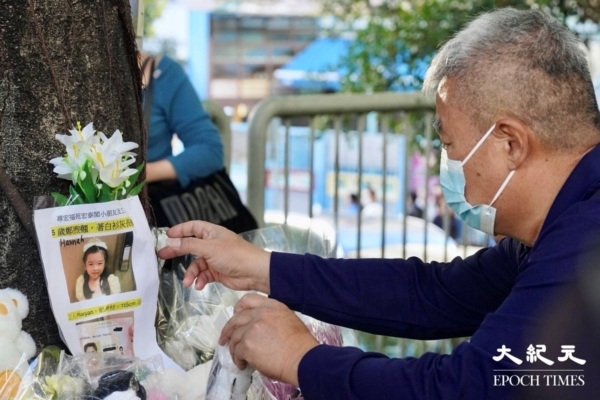
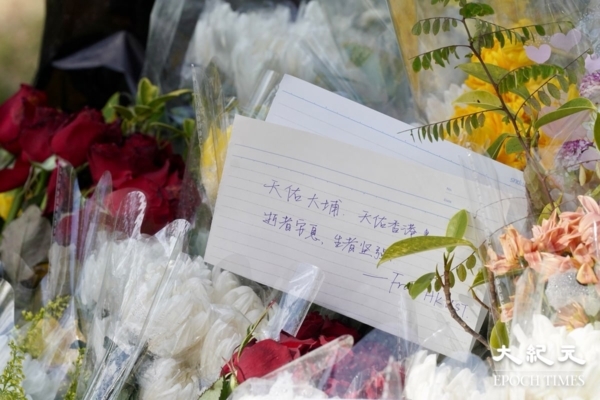
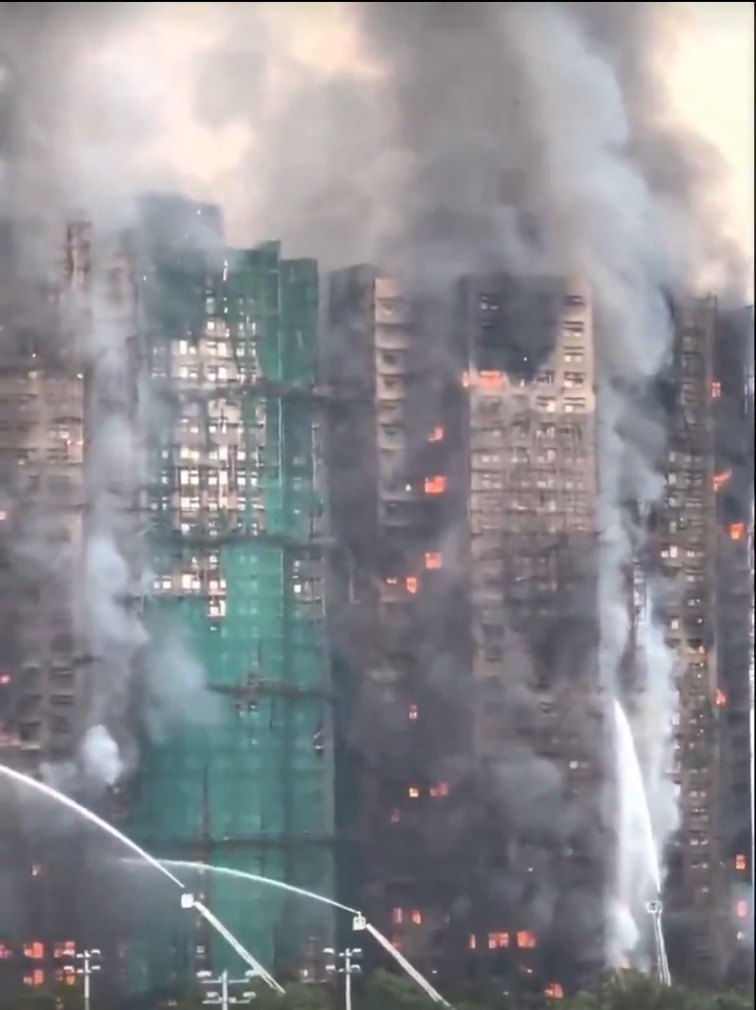
[People News] The catastrophic fire at Hong Kong’s Hong Fu Court has gripped the public’s attention. On December 1, according to official Hong Kong sources, the fire at Hong Fu Court in Tai Po has already caused 151 deaths, with more than 100 others still unaccounted for. It is believed that the number of deaths in this fire will continue to rise. In the air still filled with the smell of burning, emotions of sadness, anxiety, anger, confusion, and helplessness are everywhere. Under the political background of the CCP’s black hand fully penetrating Hong Kong and the complete purge of the democratic camp, can the truth behind this deadly fire really be made public?
Late on the first night, while the fire was still raging, Hong Kong Secretary for Security Tang Ping-keung stated that firefighters found, during their operations, that after the protective mesh on the exterior walls of the Hong Fu Court buildings caught fire, the speed and intensity of the flames spreading far exceeded that of ordinary fire-resistant materials. The situation was unusual. Police also found in the only building not affected by the fire that some windows had been sealed with foam boards that easily fueled the flames—also an unusual situation.
On the second day of the fire, Hong Kong Chief Executive John Lee Ka-chiu proactively redirected attention toward bamboo scaffolding at a press conference, stating that the government would “advance the roadmap of replacing traditional bamboo scaffolding with metal scaffolding.” Lee’s comments appeared to shift the cause of the fire toward bamboo scaffolding structures.
On the third day, after the fire was nearly extinguished, Tang Ping-keung completely changed his tune, saying that preliminary tests showed the scaffold mesh and protective netting of the buildings “met flame-retardant requirements,” but the foam boards surrounding building windows were highly flammable.
On December 1, the official narrative reversed again. Chief Secretary for Administration Chan Kwok-ki announced that among 20 samples of scaffold netting taken from four buildings—Hong Tai Court, Hong Chi Court, Hong Tao Court, and Hong Yan Court—seven samples did not meet flame-retardant testing standards.
Tang Ping-keung also admitted that although initial testing indicated the scaffold netting met standards, the observations of colleagues and experts did not align with this, so additional samples were taken from high, medium, and low floors of eight buildings, including hard-to-reach areas. Among 20 samples, seven failed to meet standards. He believed that the substandard scaffold netting, together with the foam boards, caused the rapid spread of the fire.
ICAC Commissioner Woo Ying-ming provided further details, stating that investigation into the 12 arrested suspects showed that in July, after a typhoon damaged the protective nets, those involved purchased replacement nets from a local supplier in batches. Evidence showed that at HKD 54 per roll, they bought 2,300 rolls—about 7,500 square meters—of non-flame-retardant protective netting, enough to wrap eight buildings. Later, in late October, after a fire incident in Central involving protective netting, the suspects feared inspection. They then purchased 115 rolls—about 3,700 square meters—of flame-retardant protective nets from the same supplier at HKD 100 per roll and installed them on the lower floors of each building to pass inspections by mixing inferior material with compliant material.
Public inquiries currently focus on four deadly failures that allowed the fire to rage uncontrollably:
-
Scaffold netting did not meet fire safety standards.
The Hong Kong government has now admitted that seven samples did not meet flame-retardant standards, suggesting that substandard nets were used. -
Windows were sealed with highly flammable foam boards, accelerating the spread of flames.
-
Fire-resistant windows in emergency stairwells were replaced with thin wooden boards with holes, allowing flames and smoke to enter.
-
Fire alarms in all eight buildings failed.
Once again, the investigation into the fire’s real culprit has returned to the scaffold netting.
Hong Yip Construction, the contractor responsible for the exterior renovation of Hong Fu Court, has also taken on exterior renovation projects for 11 other buildings in Hong Kong, including Fu Ka Court of Fu Cheong Estate and Yee Lok Garden. Residents of Fu Ka Court and Yee Lok Garden have shown publicly posted inspection reports indicating that the nets used in their renovations were produced by “Shandong Chenxu Chemical Fiber Rope Net Co., Ltd.” and “Binzhou Yuanjin Chemical Fiber Rope Net Co., Ltd.,” with the product named “Flame-Retardant Dense Mesh Net,” both certified by the Binzhou Testing Center in Shandong Province. Coincidentally, the registered addresses of these net manufacturers point to the area around Lizhuang Town in Huimin County, Binzhou, Shandong.
A search of China’s corporate registry shows that Shandong Chenxu Chemical Fiber was founded in 2019 with registered capital of 3 million RMB, located in Nanbei Li Village of Lizhuang Town, Huimin County, where dozens of rope-net companies are registered. Some Chinese netizens believe that with so many companies in one village producing the same type of product, some may be shell companies.
Chinese state media People’s Daily Online reported in 2020 that Huimin County is the nation’s largest chemical fiber rope-net production base, with products covering agricultural, construction, sports, gardening, and aquaculture uses. In Huimin County alone, the rope-net industry accounts for over 90% of Shandong’s market share and over 80% of the national market; thousands of rope-net manufacturers and processors operate there, employing tens of thousands.
Xinhua News Agency reported on June 12 that rope-net manufacturing is Huimin County’s leading industry, with 4,257 rope-net enterprises, more than 120,000 workers in production, and exports to more than 100 countries and regions. In 2024, the rope-net industry cluster in Huimin County reached an output value of 30.2 billion RMB.
Hong Kong independent media outlet “Green Bean” questioned why the Hong Kong government was in such a hurry to pre-announce the “elimination of bamboo scaffolding”? And why rush to “clear the name” of the scaffold nets? Because the scaffold nets involve not only construction sites in Hong Kong but an industrial chain spanning Shandong with an annual output value exceeding 30 billion RMB.
In other words, behind the scaffold nets lies a lifeline industry tied to local Chinese government finances, employment, and exports. Once the issue reaches Shandong—the “nation’s largest chemical fiber rope-net base”—the question of whether the nets met standards expands beyond Hong Kong’s construction responsibility and becomes a matter of China’s industrial chain regulation and certification system. The Hong Kong fire would then burn back toward the CCP and toward Xi Jinping.
In reality, after the destruction of One Country, Two Systems, counterfeit and substandard products under CCP rule have poured into Hong Kong. With the forced implementation of the National Security Law, Hong Kong’s democracy and freedom have nearly vanished. In investigating the truth behind the fire, political checks and balances have disappeared, oversight bodies have become rubber stamps, unscrupulous businessmen and corrupt officials operate with impunity, and citizens’ calls for accountability are suppressed as “using disaster to disrupt Hong Kong.” The CCP’s dictatorship has spread over all of Hong Kong. The Hong Kong fire once again proves that as long as the CCP’s black hand exists, disasters will continue.
(First published by People News)
△






News magazine bootstrap themes!
I like this themes, fast loading and look profesional
Thank you Carlos!
You're welcome!
Please support me with give positive rating!
Yes Sure!