
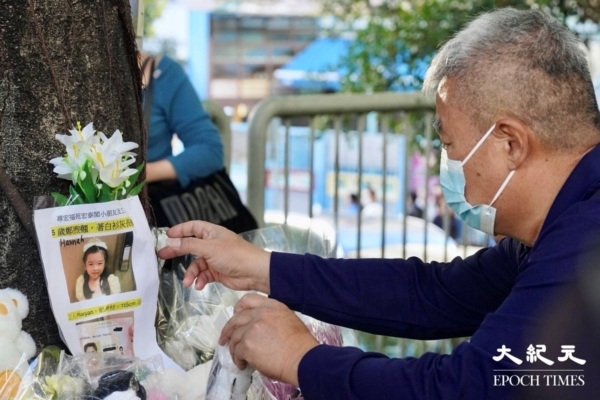
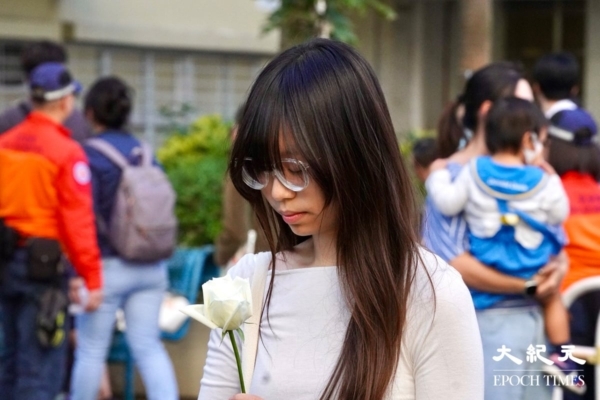
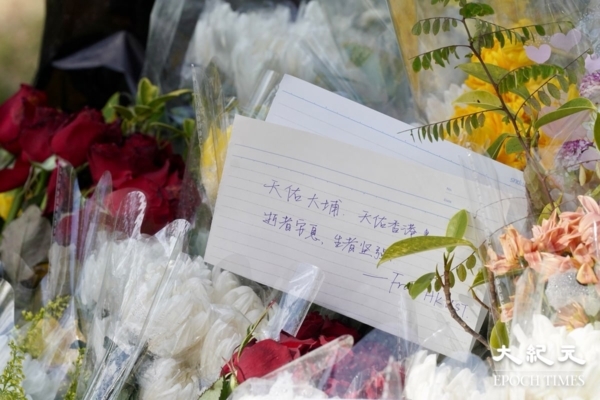
On November 29, 2025, citizens gathered near the fire scene to mourn. (Yu Gang / The Dajiyuan)
[People News] As Hong Kong residents are grieving and infuriated by the Hong Fook Court fire, the CCP arrested CUHK student Kwan Ching-fung, who called for an independent investigation. They fabricated the charge of “using the disaster to cause chaos in Hong Kong,” attempting to intimidate Hongkongers and suppress the public’s righteous demands. This tactic will never succeed.
Meanwhile, even within the pro-establishment camp, there are differing voices on whether to launch an independent investigation. According to reports, some Legislative Council members and Executive Council members have stated that if an independent investigation committee is not set up, it would be illogical. Former Secretary for Transport and Housing Anthony Cheung, and even the current Convenor of the Executive Council Regina Ip, both advocate for resolving the current impasse through an independent investigation committee.
In other words, CUHK student Kwan Ching-fung’s call is, to a considerable degree, supported by Anthony Cheung and Regina Ip. So on what legal basis did the Hong Kong police arrest Kwan? Of his four demands, only the independent investigation is questioned by the authorities; the other three are indisputable. Since even within the pro-establishment camp there are differing views on an independent investigation—meaning the matter is still under discussion—does this mean only officials are allowed to discuss it while the public must remain silent?
The Office for Safeguarding National Security and the Hong Kong government label any public statements that differ from the official narrative as “using the disaster to cause chaos in Hong Kong.” Such convenient scapegoating and shirking of responsibility will only intensify public resentment, worsen the current situation, and place the government in an even more passive position.
Can the widespread public anger across Hong Kong be covered up through scapegoating? This is a habitual trick rooted in the CCP’s “peasant-style thinking.” They completely fail to understand Hongkongers. They do not realize that a certain “Hong Kong spirit” has long been cultivated in this former British colony—deeply ingrained in our thoughts and daily lives. That spirit is: Do not treat the public like fools!
The John Lee administration panics at the mere mention of an independent investigation, because such an investigation would be beyond government control. It might expose extensive wrongdoing within the administration, possibly causing certain officials to fall, and even affecting John Lee’s own position. But with a disaster at hand, public anger is soaring, and even the pro-establishment camp is trying to protect itself—turning the usual covert power struggles into openly opposing the government—thus producing differing opinions.
Voices like those of Anthony Cheung and Regina Ip can be interpreted as personal attempts to win public favor, or as recommendations to help the government find a way out. In reality, the one measure that could truly help the government escape this crisis is precisely the establishment of an independent investigation committee.
Given the current level of public resentment, if the independent investigation committee is ruled out and the government investigates itself—evading and muddling through—no matter what, the result will be unconvincing and lack credibility. In the end, doing such an investigation would be worse than doing nothing, and the lingering social anger from the disaster would only intensify, continuing to burden the John Lee administration.
Is there any need to shield unscrupulous businessmen whose offenses caused deaths and injuries? Unless the government colluded with them, severely punishing them is in fact an opportunity for the administration to regain public trust. Is there any need to protect officials who must be held accountable for wrongdoing? If John Lee has any political sense at all, he should understand the logic of sacrificing pawns to save the king.
Rather than dying together with crooked businessmen and culpable officials, the government should impose strict penalties according to law and regulation. But before punishment, it must have solid evidence to present in court—and to obtain that evidence, it must rely on an independent investigation. When a government has lost public credibility, only an independent investigation can restore its damaged image.
Using authoritarian tools—arresting people and instilling fear—in an attempt to suppress public anger is a common CCP method for handling social issues in mainland China. But this approach will not work in Hong Kong, because the independent spirit and free character of Hongkongers cannot be compared to the long-conditioned obedience of mainland grassroots citizens who have been brainwashed for years. When it comes to right and wrong, good and evil, Hongkongers have their own judgment and will not be manipulated by the government.
Even if the CCP and the John Lee administration insist on heavy-handed tactics and use stability-maintenance forces to suppress the immediate public anger, that anger will not disappear. It will only go underground, becoming the seed for the next, broader, and more intense resistance movement.
Circumstances are stronger than individuals. The CCP is currently facing the worst social conditions since its founding. Various forms of resistance are brewing across society. When such resistance becomes widespread and the CCP is overwhelmed, that will be the moment when Hongkongers once again organize themselves to settle accounts with the CCP and the Hong Kong government for their blood debts.
From the perspective of stability maintenance, hard repression is one option; responding to public demands is another. Which option benefits the CCP depends entirely on Xi Jinping’s single thought. Xi, as a “princeling,” has the temperament of “I alone rule the world,” eliminating anyone who defies him. With such an attitude as the foundation, whether an independent investigation committee will eventually be established remains to be seen.
In fact, given the current internal and external situations, how “independent” an investigation committee led by the Hong Kong government could truly be is itself questionable. Chief Justice Andrew Cheung of the Court of Final Appeal has long been on the U.S. sanctions list. Even if he were to lead the independent investigation committee, its credibility would still be in doubt.
Nevertheless, having an independent investigation is still better than having none. At least it could help the government survive the immediate political crisis. But before establishing such a committee, the authorities must first withdraw the charges against student Kwan Ching-fung. Because once an independent investigation committee is set up, it proves that his four demands were entirely legitimate—foresighted, morally grounded—and he should be awarded a Citizen Responsibility Award.
(Author’s Facebook) △





News magazine bootstrap themes!
I like this themes, fast loading and look profesional
Thank you Carlos!
You're welcome!
Please support me with give positive rating!
Yes Sure!